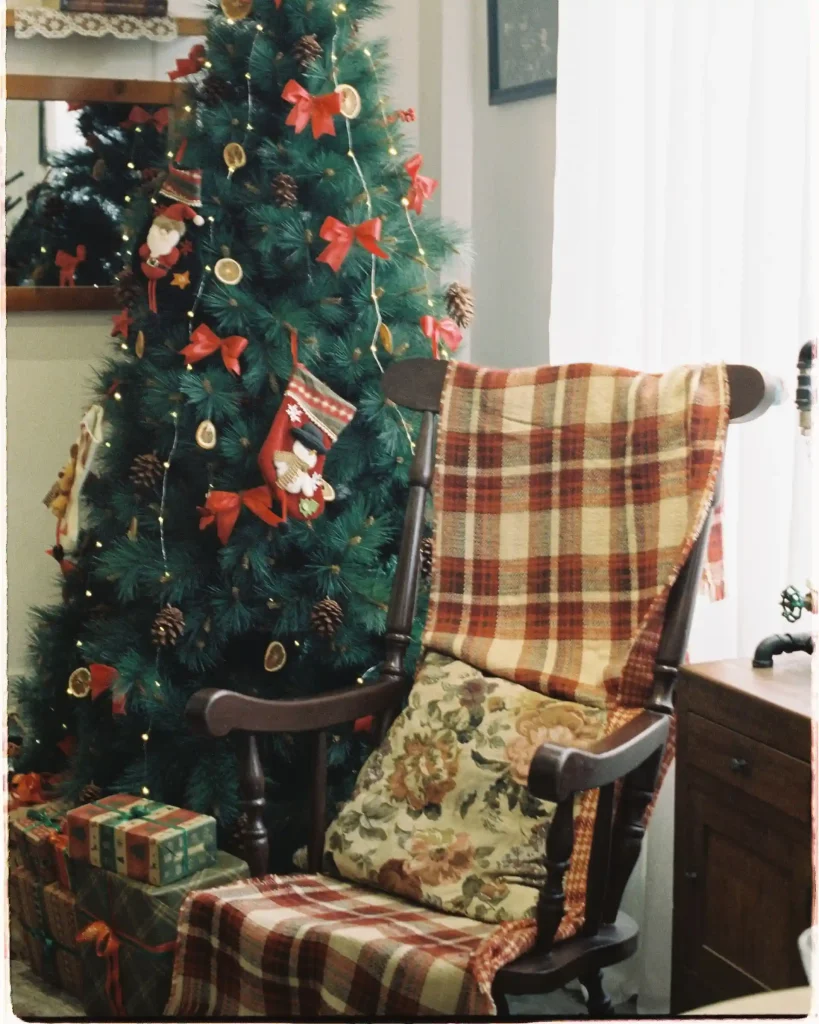

The Empty Chair at Christmas
There is something about Christmas that makes us notice the people who are missing. The decorations may be brighter, the music may be louder, and the house may be filled with the familiar smell of holiday food, but an empty chair at Christmas can make everything feel different. For families who have lost someone they love, the holidays can bring back memories that have been quietly resting throughout the year.
At the Carter family’s Christmas table, there had always been twelve chairs. Twelve places were set every Christmas Eve, no matter how many people were expected to arrive. The tradition had started with Grandma Eleanor, the woman who believed Christmas dinner was the most important meal of the year.
This year, there were only eleven people.
Yet twelve chairs still surrounded the table.
The twelfth chair belonged to Grandma.
Nobody had officially decided to leave it empty. No family meeting had been held. Nobody had suggested moving it into another room. It simply remained there, exactly where it had always been.
And somehow, that empty chair said everything nobody wanted to say.
Christmas Without a Loved One
Grandma Eleanor had passed away several months earlier, but her absence felt especially painful during the Christmas season. Throughout the year, the family had slowly adjusted to not hearing her voice, not receiving her phone calls, and not seeing her sitting in her favorite chair.
Christmas was different.
Christmas had always belonged to Grandma in some way.
She was the person who insisted that everyone come home. She made the same apple pie every year. She decorated the house before anyone else was ready. She complained when the Christmas lights were tangled and then spent an entire afternoon untangling them herself.
She also had a habit of telling the same family stories over and over again.
When the children were younger, they would roll their eyes.
Now, they would have given anything to hear those stories one more time.
For Emily, Grandma’s oldest granddaughter, the thought of Christmas without her felt impossible. Every holiday memory seemed to have Grandma somewhere in the background.
There she was in old photographs.
There she was standing beside the Christmas tree.
There she was holding a plate of cookies.
There she was laughing at the dinner table.
And now there was only the chair.
A Family Struggling With Holiday Grief
Holiday grief can be complicated because Christmas is often associated with happiness, family gatherings, traditions, and memories. When someone important is no longer there, those same traditions can become reminders of what has changed.
For the Carter family, the first Christmas without Grandma was not simply another holiday.
It was a new version of Christmas that nobody had asked for.
Emily arrived at her parents’ house early on Christmas Eve. Her mother was preparing dinner in the kitchen while her father worked outside on the Christmas lights. Her younger brother, Daniel, was helping his daughter Sophie decorate cookies.
Everything looked familiar.
The Christmas tree stood beside the window.
The stockings were hanging above the fireplace.
The dining table was covered with Grandma’s old holiday tablecloth.
Then Emily saw the empty chair.
She stood there for a moment.
“Mom,” she finally said, “are we leaving Grandma’s chair there?”
Her mother stopped what she was doing.
She looked toward the dining room.
“I don’t know,” she answered.
Neither of them knew what the right thing to do was.
Should they move the chair away so they wouldn’t have to look at it?
Should they set a place for Grandma?
Should they pretend nothing had changed?
There were no rules for this kind of Christmas.
The Christmas Dinner
That evening, the family sat down for dinner.
There was turkey, mashed potatoes, roasted vegetables, homemade bread, and Grandma’s famous apple pie.
The food was almost exactly the same as it had been every year.
But the room felt different.
Emily’s father raised his glass.
“To family,” he said.
Everyone raised their glasses.
Then silence followed.
Usually, Grandma would have interrupted the moment with a joke.
She might have complained about the turkey.
She might have asked why everyone was eating so slowly.
She might have told someone to pass the potatoes even though they were sitting directly in front of her.
But this year, there was nothing.
Nobody wanted to be the first person to mention her.
Then Sophie looked at the empty chair.
“Where’s Grandma?”
The adults became quiet.
Emily’s mother took a breath.
“Grandma isn’t here this Christmas, sweetheart.”
Sophie looked confused.
“Is she coming later?”
Her grandmother shook her head.
“No, honey.”
Sophie looked at the chair.
“But that’s her chair.”
Emily smiled sadly.
“Yes. It is.”
The Memory Hidden in the Attic
After dinner, Emily went upstairs because she needed a few minutes alone.
She passed the attic door and suddenly remembered Grandma’s Christmas decorations.
After Grandma died, the family had packed many of her belongings into boxes. They had told themselves they would sort everything later.
Later had never come.
Emily opened the attic door.
Dusty boxes filled the small space.
She found one marked “Christmas.”
Inside were old ornaments, ribbons, Christmas cards, photographs, and decorations that Grandma had collected throughout the years.
At the bottom of the box was a small wooden container.
Inside it were several photographs.
Emily picked them up one by one.
There was a photograph of Grandma holding her as a baby.
There was one of Grandma and Grandpa beside their first Christmas tree.
There was another of the entire family gathered around the Christmas table.
Then Emily found an envelope.
Her name was written across the front.
She immediately recognized Grandma’s handwriting.
Emily sat on the attic floor and opened it.
Grandma’s Christmas Letter
The letter was short, but every sentence felt important.
Grandma had written about family, Christmas, and how quickly the years passed.
She wrote about how children eventually grew up, moved away, started families, and created traditions of their own.
Then she wrote something Emily never expected to read.
She said that one day, the family might sit around the Christmas table and notice that one of the chairs was empty.
She said they might feel sadness.
They might wish they could turn back time.
But she asked them not to spend the entire holiday looking at what was missing.
Instead, she wanted them to look at the people who were still sitting around the table.
Emily read the letter twice.
Then she cried.
It felt as though Grandma had somehow prepared them for this moment.
Remembering a Loved One at Christmas
Emily carried the letter downstairs.
Her mother immediately recognized the handwriting.
“She wrote that?”
Emily nodded.
The family gathered around her.
They read Grandma’s words together.
For several minutes, nobody spoke.
Then Daniel laughed.
“That sounds exactly like her.”
Everyone smiled.
The tension in the room began to disappear.
They started talking about Grandma.
They remembered the Christmas when she accidentally burned the cookies and blamed the oven.
They remembered how she always saved wrapping paper.
They remembered her terrible singing.
They remembered how she danced in the kitchen while preparing dinner.
They remembered how she gave everyone advice, even when nobody had asked for it.
They laughed.
Then they cried.
Then they laughed again.
The empty chair was still there.
But it no longer felt quite as painful.
It had become a place where memories seemed to gather.
Creating a New Christmas Tradition
Sophie disappeared into the living room and returned carrying a small piece of paper.
“I made something for Grandma,” she said.
It was a drawing of the family sitting around the Christmas table.
There were twelve chairs.
Grandma’s chair was filled with a picture of a smiling woman wearing a red sweater.
Sophie had colored the entire picture herself.
Emily looked at it carefully.
“That’s beautiful.”
Sophie pointed toward the drawing.
“Grandma is still with us.”
Emily hugged her.
“Yes,” she whispered. “She is.”
The family decided to place the drawing on Grandma’s empty chair.
Nobody planned it.
Nobody discussed it.
It simply felt right.
That small drawing became their new Christmas tradition.
Every year afterward, the family would place something meaningful on Grandma’s chair. Sometimes it was a photograph. Sometimes it was one of her old ornaments. Sometimes it was a handwritten note from a grandchild.
The chair remained empty.
But it was never forgotten.
Making New Memories During the Holidays
One of the hardest parts of losing someone is realizing that future memories will happen without them.
There will be birthdays they won’t attend.
Dinners they won’t sit through.
Christmas mornings they won’t witness.
At first, creating new memories can feel almost wrong because the old ones are so precious.
But eventually, families learn that new memories do not erase old ones.
They add to them.
The following Christmas, Sophie was older and more excited about the holiday than ever. She spent part of Christmas morning coloring and creating her own little holiday scenes with the family nearby. A simple activity such as the Snoozle Beach Fun Coloring Book gave her a quiet creative moment during the busy holiday morning.

Emily watched her coloring and thought about Grandma.
She imagined Grandma sitting beside Sophie, asking why she had used so many colors.
The thought made Emily smile.
That was the strange thing about memories.
Sometimes they hurt.
Sometimes they made you cry.
And sometimes, after enough time had passed, they made you smile again.
When Christmas Does Not Feel the Same
The truth is that Christmas after losing someone may never feel exactly the same.
And that is okay.
There is often pressure during the holiday season to be cheerful, grateful, and excited. But grief does not disappear simply because Christmas lights are hanging from the windows.
For some people, Christmas can intensify feelings of sadness, loneliness, and nostalgia. Grief can become especially noticeable when familiar traditions suddenly have an unfamiliar absence.
Families do not have to force themselves to recreate the Christmas they had before.
They can change traditions.
They can create new ones.
They can keep certain traditions exactly the same.
They can talk about the person who is gone.
They can laugh about old stories.
They can cry when memories become overwhelming.
There is no single correct way to celebrate Christmas after a loss.
What matters is allowing the family to make room for both grief and love.
The Meaning of an Empty Chair
An empty chair at Christmas can look like a symbol of loss.
But it can also become a symbol of love.
The chair represents someone who mattered.
Someone whose presence changed the family.
Someone whose stories became part of the family’s history.
Someone whose traditions continue even after they are gone.
For some families, intentionally leaving an empty chair can be a meaningful way to acknowledge a loved one’s absence rather than pretending it does not exist. Other families may prefer a photograph, candle, favorite ornament, or another remembrance. What matters is choosing something that feels comfortable and meaningful for the family.
The Carter family chose the chair.
It reminded them that Grandma had been there.
It reminded them that she had loved them.
And it reminded them that the family still had one another.
The Christmas That Changed Everything
Years later, Emily would still remember that Christmas.
It was not the happiest Christmas she had ever experienced.
It was not the easiest.
But it was one of the most meaningful.
The family had learned something important.
They did not have to choose between remembering Grandma and enjoying Christmas.
They could do both.
They could miss her and still laugh.
They could cry and still celebrate.
They could look at the empty chair and still be grateful for the years when it was occupied.
That is the complicated beauty of Christmas memories.
They remind us that life changes.
Children grow up.
Parents grow older.
Grandparents leave us.
Families become bigger and smaller.
Traditions evolve.
But love can continue through all of those changes.
A Christmas Story About Love, Memories, and Family
On Christmas Eve many years later, Emily sat at the same table.
The same twelve chairs surrounded the room.
Grandma’s chair was still there.
Sophie, now a young woman, had become the person responsible for bringing Grandma’s apple pie to Christmas dinner.
She placed the pie on the table and smiled.
“Grandma would probably say I didn’t make enough.”
Everyone laughed.
Emily looked toward the empty chair.
There was a small photograph resting on it.
It showed Grandma smiling beside the Christmas tree.
For a moment, Emily imagined hearing her voice.
She imagined the familiar laugh.
She remembered the stories.
She remembered the cookies.
She remembered the advice.
Most importantly, she remembered the love.
The chair was empty.
But the room was full.
Full of children who had grown up.
Full of people who had become parents.
Full of new traditions.
Full of old stories.
Full of memories.
And full of the love Grandma had left behind.
Emily finally understood what Grandma had meant in her letter.
The empty chair was never supposed to be the thing they focused on.
It was supposed to remind them to look around the table.
To notice who was there.
To appreciate the conversations.
To enjoy the meal.
To make the memories that would someday become the stories their children told.
Because Christmas is not only about the people who are missing.
It is also about the people who are still here.
The Lesson of the Empty Chair at Christmas
An empty chair at Christmas can represent many things. It can represent grief, love, memory, family, tradition, and the passage of time.
For anyone spending Christmas without a loved one, the holiday may feel different. The decorations may bring back memories. A favorite song may suddenly feel painful. A familiar recipe may remind you of someone who used to prepare it. Even an ordinary chair can become a powerful reminder of the person who once sat there.
But an empty chair can also remind us of something beautiful.
Someone was here.
Someone was loved.
Someone left memories behind.
And those memories still matter.
The best way to honor a loved one at Christmas may not be to pretend that their absence does not hurt. It may be to acknowledge the sadness while also appreciating everything that person gave the family.
Tell their stories.
Make their favorite recipe.
Look through old photographs.
Keep a meaningful tradition.
Create a new one.
Say their name.
Laugh about the funny memories.
And most importantly, look around the table.
Notice the people who are still there.
Because one day, the ordinary Christmas moments happening right now may become the memories your family treasures most.
The empty chair may remain.
But so will the love.
And perhaps that is the greatest Christmas gift of all.